
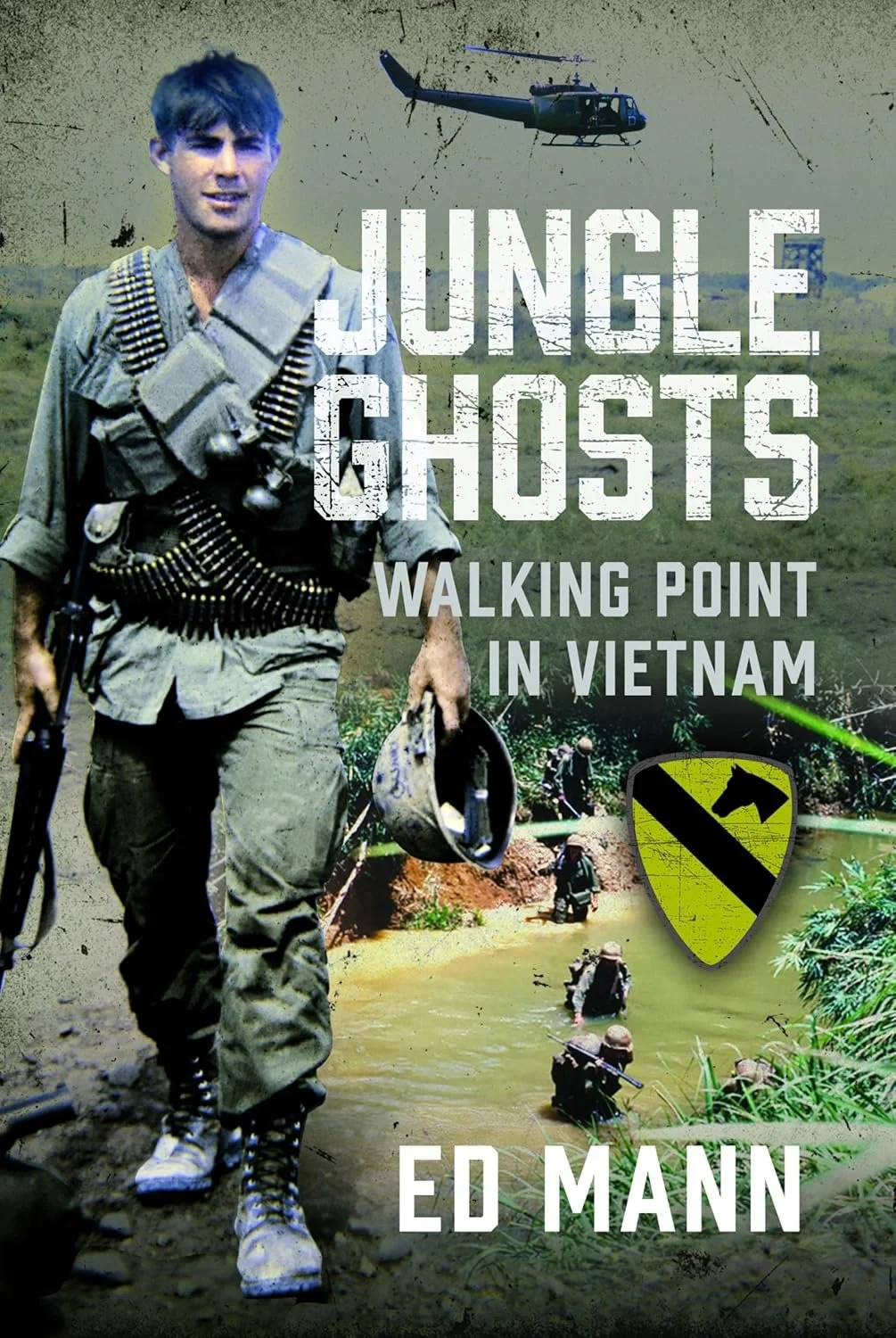
Click on cover image to purchase a copy
MWSA Review
Ed Mann’s Jungle Ghosts: Walking Point in Vietnam immerses you into the Vietnam War’s most heart-stopping duty. Be prepared to experience all the senses as you read this visceral and candid account of patrolling the jungle. Ed doesn’t just make you feel the jungle and the adrenaline of easing into the ambush kill zone. His portrayal of his fellow soldiers brings them to life.
I picked up my eBook version and found myself unable to put it down until my eyes could no longer ghost with Ed from cover to cover. Walking point was one of the most dangerous duties of the entire war. Untrained or unskilled soldiers often only discovered the enemy after it was too late. While the North Vietnamese soldiers were experts in harnessing the natural concealment of the jungle, the same jungle was neutral and offered indicators of human presence. Ed put his childhood experiences in the woods to use to offer himself and his squad better odds. By sharing his experiences, Ed provides insights any modern soldier would want to master. His transformation in combat illuminates the mental and moral challenges so many of our soldiers must face.
Review by Galen Peterson
Author's Synopsis
Jungle Ghosts: Walking Point in Vietnam is a narrative nonfiction account of an infantry soldier’s tour of duty in 1969-70. Described by a Vietnam Veterans Association reviewer as a “beautifully written, exquisitely detailed Vietnam War memoir [that] is almost a literary work of art,” the book offers a raw, bottom-up perspective of the conflict.
At barely 20 years of age, the author was a low-ranking enlisted man stepping beneath a jungle canopy for the first time with eyes wide with wonder. At that moment he knew little about the war in the jungle, but what he experienced that day led him to a decision that would follow him throughout his year in Vietnam: that to survive he had to rely on his own judgment, regardless of rank. In the rigid world of the military, this meant risking the severe legal consequences of disobeying orders under Article 92 of the UCMJ, even if it later became apparent that the commander had issued a terrible order that would have led to a disaster.
The book avoids lecturing, opening a window to a dim, leaf-littered world where men fought and died on a jungle floor that was hidden from the sky. The story captures raw hardships, inner reflections, the fears and courage of fellow soldiers, and the lethal commitment of the enemy. It also confronts the systemic challenges of a complex military bureaucracy that proved institutionally incapable of evaluating its own performance.
This is not a story of a hero, but of a survivor. The author recounts how seductive the adrenaline-pounding danger was, reawakening long-buried survival instincts so that fleeting jungle sounds, scents, and images began to flow through him unimpeded by slow analytical processing. He learned to recognize subtle nudges of alarm generated by his subconscious brain, and experience taught him to do whatever felt right without questioning why.
Though deeply regretting the brutality of the war, the author treasured the spellbinding connection he had with the natural voices, scents, sights, and feels of Vietnam’s ancient jungle. That connection is vividly illustrated in sections of the narrative that describe the living, breathing, animal and insect-filled ecosystem whose messages were his lifeline.
While many combat memoirs focus heavily on the aftermath of war, Jungle Ghosts closes with the still-haunting memory of his imperiled fellow soldiers looking up at the author as a helicopter lifts him from the jungle floor for the final time.
Format(s) for review: Paper or Kindle
Review genre: Nonfiction—Memoir/Biography
Pages/Word count: 325 / 135,000