
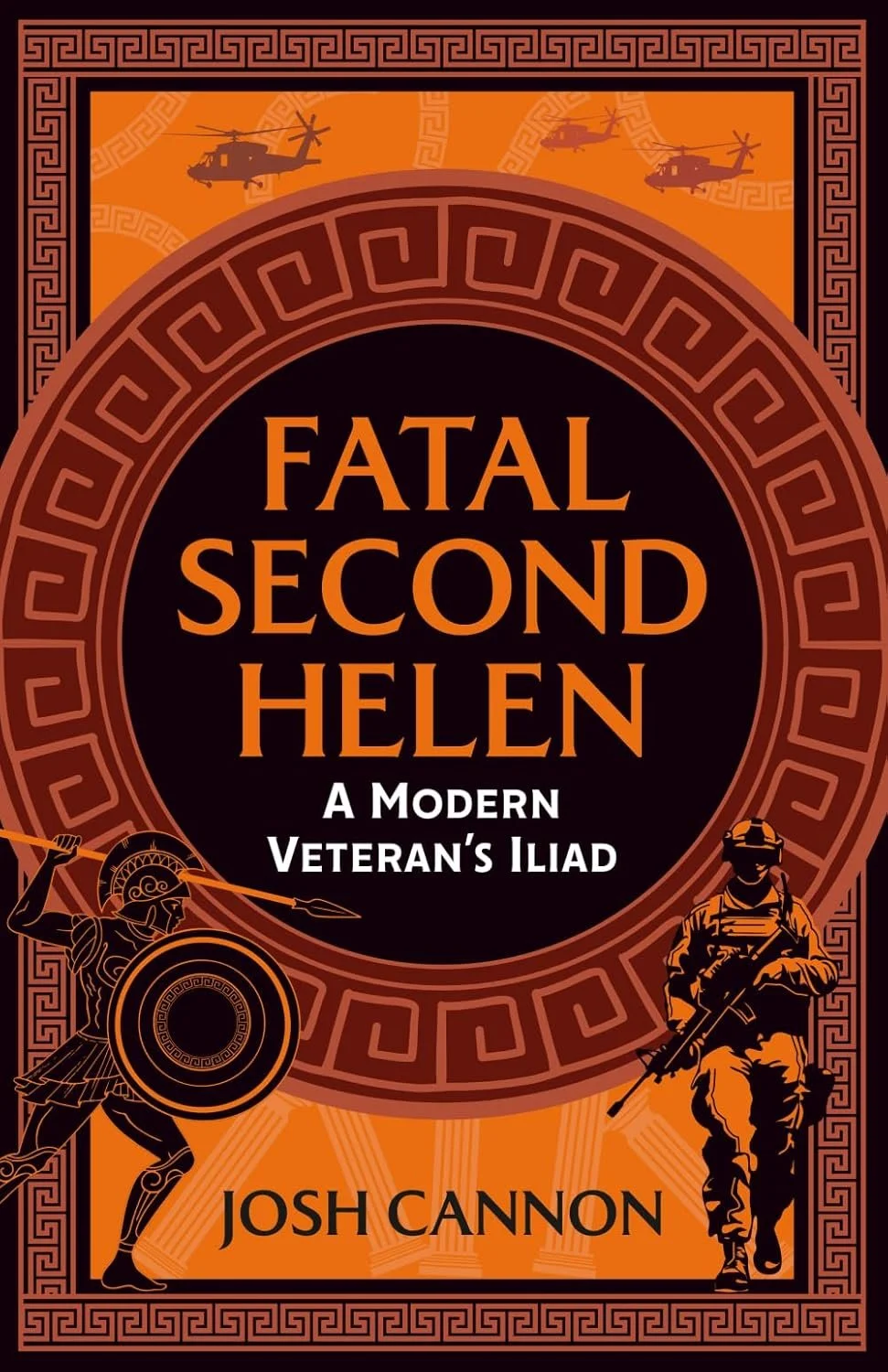
Click on cover image to purchase a copy
MWSA Review
Mention The Iliad to people today, and the first thing that might come to mind to many is the 2004 movie Troy, while a few might say it was that boring book from high school. To Fatal Second Helen author and Marine veteran Josh Cannon, it was a way to square away many aspects of his service in Iraq during wartime by comparing and contrasting his experiences to the oldest war story and the oldest book in the history of Western Civilization.
Cannon, who served as an enlisted Arabic Cryptologic Linguist and deployed to Iraq twice (first with the invasion in 2003, and again in 2004), is eminently qualified to write this book. After his time with the Marines, he attended the University of Pittsburgh and then the University of Chicago, where he received his PhD, ultimately becoming the Director of Research, and an adjunct faculty member for the Classics Department and the Anthropology Department. He has also worked on numerous archaeological digs in Turkey, including ones that interacted with the location thought to be the site of Troy.
Despite the heady subject and academic credentials of the author, it is quite an enjoyable and very insightful read. The author deftly highlights how, at the level of the individual warrior, most of the physical, emotional, and psychological elements of war and its aftermath, can be found in The Iliad, including possibly the first documented “blue falcon” in the history of military service.
This fine book will be of interest to veterans, students of military history and ancient times, and anyone who is seeking to understand the effects of war on those who have served.
Review by Terry Lloyd (January 2026)
Author's Synopsis
In the tradition of Jonathan Shay’s 'Achilles in Vietnam' (1994), Josh Cannon’s 'Fatal Second Helen: A Modern Veteran’s Iliad' brings to the audience a discussion of Homer’s Iliad that allows the ancient text to teach us about modern war. Cannon’s work differentiates itself from Shay’s by discussing the Iliad holistically. His book seeks to demystify the Iliad through connecting it to his military service via a presentation of his personal stories.
By sharing his story, Cannon’s book shares a new angle on an old tale. He makes the Iliad accessible to any audience and helps unearth a lesson that, despite being millennia old, still has much to teach us.
Format(s) for review: Paper or Kindle
Review genre: Nonfiction—Memoir/Biography
Pages/Word count: 178 / 50,000