Want to Put Song Lyrics in Your Book? Read This First.
Many writers want to include song lyrics in a novel, memoir, essay, or poetry collection. The instinct is understandable. A single lyric can evoke a time period, a memory, a deployment, a romance, a funeral, a protest, a road trip, or an entire generation.
But song lyrics are among the riskiest copyrighted material an author can quote.
This article is not legal advice. It is practical guidance for MWSA members and authors submitting books to the MWSA awards program.
The short answer
If you want to quote song lyrics in a book, assume you need permission unless you have a solid, documented reason to rely on fair use.
That does not mean fair use never applies. It does mean that “I only used a few lines,” “I credited the songwriter,” “the song is famous,” “my book is nonfiction,” “my publisher approved it,” or “my book is registered with the Copyright Office” does not automatically make the use legal.
Why are song lyrics different?
Song lyrics are usually short, creative, and highly protected works. Because songs are brief, even a few quoted lines may represent a meaningful portion of the work. A lyric can also be the most recognizable or memorable part of the song—the “heart” of the work.
That is why authors should be more cautious with lyrics than with short quotations from a long nonfiction book, a government document, a newspaper article, or a historical source.
Attribution is not permission
Giving credit is good practice, but credit does not replace permission.
You can properly identify the songwriter, performer, publisher, album, and year, and still have a permissions problem. Copyright is about the right to reproduce protected expression. Attribution answers the question, “Who created this?” It does not answer the question, “Did I have the legal right to use it?”
Copyright registration does not clear third-party material
Registering your book with the U.S. Copyright Office does not mean every quotation, lyric, photograph, poem, map, letter, or other third-party item in the book has been cleared.
A copyright registration creates a public record of your copyright claim in your own work. It is not a legal opinion that all borrowed material inside the book is permitted.
What fair use actually means
Fair use is a limited exception that allows some use of copyrighted material without permission. It is not a blanket rule. It is not a word-count rule.
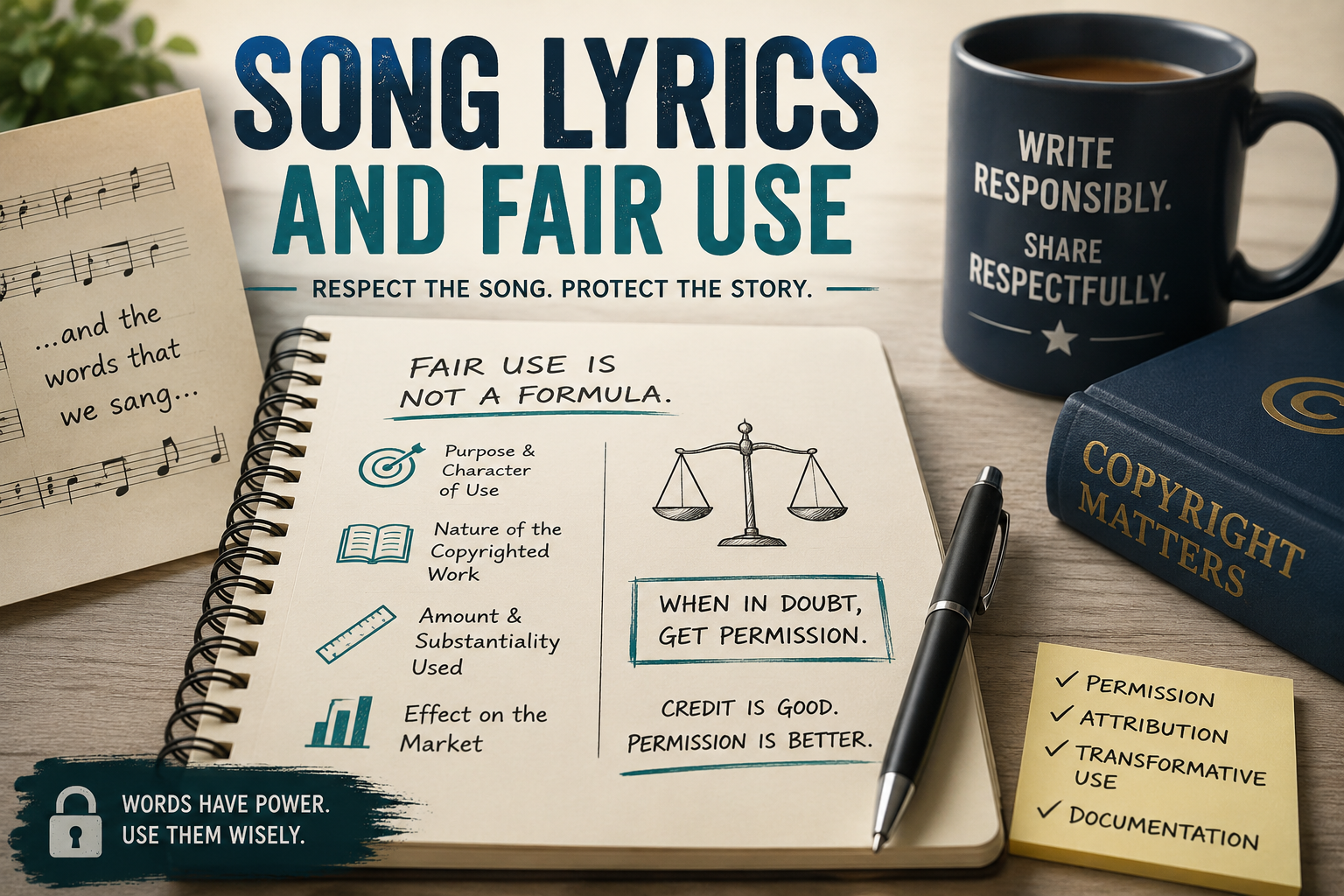
Fair use is evaluated case by case under four factors:
The purpose and character of the use
The nature of the copyrighted work
The amount and substantiality of what was used
The effect of the use on the potential market for the original work
All four factors matter. No single factor automatically controls the answer.
Common misunderstanding: “It’s only one line”
There is no automatic “one line is okay” rule.
A short quotation from a long factual work may be low risk. A short quotation from a song lyric can be higher risk because the song itself is short and the quoted phrase may be central, memorable, or commercially valuable.
The question is not only “How much did I use?” It is also “What did I use, why did I use it, and did I use more than necessary?”
When fair use is more likely
Fair use is stronger when the author is using the lyric for criticism, commentary, scholarship, teaching, parody, or analysis.
For example, a music critic discussing the meaning of a lyric may need to quote a few words or lines to make the point. A historian analyzing protest music may need to quote limited lyric excerpts as evidence. A memoirist discussing how a song reflects the culture of a specific time may have a stronger argument if the lyrics are analyzed directly rather than merely included for atmosphere.
Even then, the author should use only what is necessary.
When fair use is weaker
Fair use is weaker when lyrics are used mainly for mood, decoration, nostalgia, emotional effect, scene-setting, or because a character is listening to or singing the song.
Examples of higher-risk uses include:
opening a chapter with a song lyric as an epigraph;
having a character sing several lines of a popular song;
quoting lyrics to create the emotional tone of a scene;
using lyrics because they “fit the moment”;
including lyrics without discussing or analyzing them;
using lyrics from multiple songs throughout the book.
Those uses may be artistically effective, but they are usually not the strongest fair-use cases.
“But my publisher approved it”
That may matter, but it does not end the question.
A reputable publisher may have obtained permission, reviewed the use, or made a fair-use determination. If so, the author should be able to provide documentation. But the fact that a book was traditionally published does not, by itself, prove that all lyrics were cleared or that a fair-use analysis was performed.
“But my attorney said it was fair use”
That may be enough for your own risk tolerance, but be prepared to document it.
MWSA does not need privileged legal advice or a full attorney-client memo. But if a submitted book contains song lyrics and the author relies on fair use, MWSA may ask for written confirmation that the lyric use was reviewed and determined to be permissible.
What authors should do instead
The safest choices are:
Get written permission from the rights holder.
Remove the lyric.
Refer to the song title without quoting the lyrics.
Paraphrase the effect of the song without reproducing protected language.
Write your own fictional lyric.
Use public-domain lyrics, but verify the public-domain status first.
Song titles are usually safer to mention than lyrics. For example, writing that a character heard “Fortunate Son” on the radio is very different from quoting lines from the song.
Public domain is not the same as “old”
Do not assume a song is in the public domain because it was popular decades ago, because the songwriter is deceased, or because the song is easy to find online.
Copyright duration can be complicated. There may be separate rights in the lyrics, musical composition, arrangement, and sound recording. If public-domain status matters to your book, verify it carefully.
MWSA’s position on submitted books
MWSA is not a law firm and does not make legal rulings on copyright infringement. However, MWSA may decline to review, score, award, or publish a review of a book if unresolved copyright or permissions concerns are identified.
For books submitted to MWSA, authors are responsible for ensuring that quoted song lyrics and other copyrighted materials are properly used. If questions arise, MWSA may ask the author to provide documentation showing that:
permission was obtained; or
the use was reviewed and determined to be fair use; or
the material is in the public domain.
If the concern cannot be resolved, MWSA may withdraw the book from review or decline to publish a review. This protects the author, the reviewers, and the awards program.
Bottom line
Fair use is real, but it is often misunderstood.
The safest rule for authors is this: if you quote song lyrics in your book, either get permission, have a documented fair-use basis, or leave the lyrics out.
A song title, a memory of the song, or a description of how the song made someone feel will usually do the job without creating the same risk.
Further Reading and Sources
https://www.copyright.gov/fair-use/
https://fairuse.stanford.edu/overview/introduction/getting-permission/
https://authorsguild.org/resource/fair-use-for-authors/
Click here to read our earlier article on this subject.
Note: image is AI-generated.