

Date of interview: 19 March 2026
Steven-Paul Lapid, a native of Detroit, MI, is a retired U.S. Navy officer, author, and military analyst whose career provides a rare 360-degree perspective on military leadership. With over 25 years of service, he has led sailors across a wide spectrum of the naval profession, from surface warships and joint commands to Naval Special Warfare units. His journey is uniquely defined by his rise from the deckplates as an enlisted Sailor to a commissioned officer via the Seaman-to-Admiral-21 program, giving him firsthand insight into leadership challenges and opportunities at every level of the chain of command.
Throughout his career, Lapid built a reputation for effective mentorship and for forging cohesive, high-performing teams. His operational tours on various warships, combined with key shore assignments at units including SEAL Team Three, provided him a deep well of real-world experience. Today, he continues to shape the future of the fleet, serving as the senior training and warfighting readiness policy analyst in support of Commander, Naval Surface Force, U.S. Pacific Fleet (COMNAVSURFPAC).
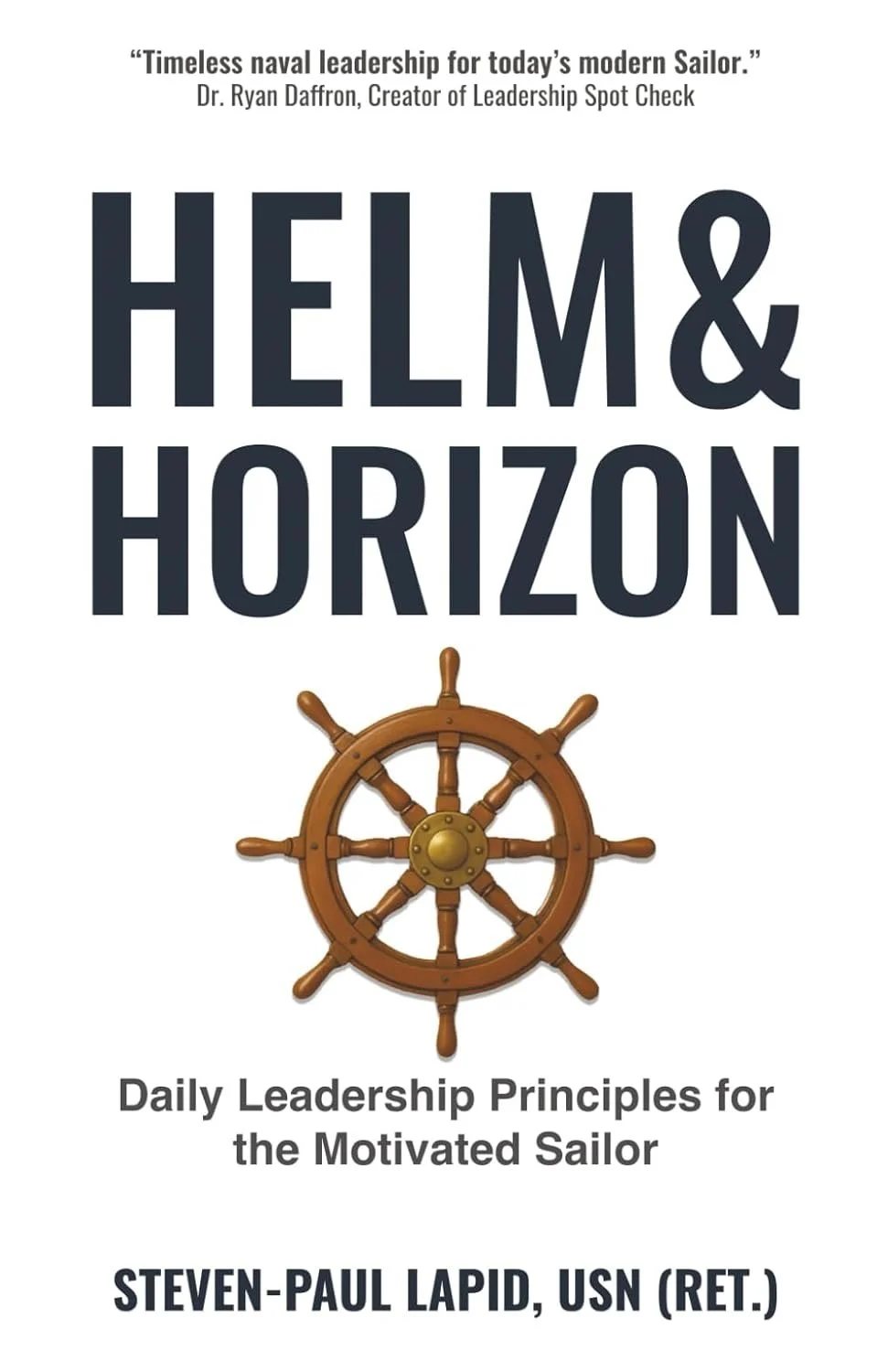
Beyond his direct support to the Navy, Lapid is a prominent voice in military professional development. He is the author Helm & Horizon: Daily Leadership Principles for the Motivated Sailor, a daily guide designed to empower service members and veterans with actionable principles on character, responsibility, and personal growth.
MWSA: What do you think are the main benefits of being an MWSA member?
Steven-Paul Lapid, USN (Ret.): The greatest benefit is the community. You are immediately connected with a network of fellow service members, veterans, and family members who understand the unique journey of turning military experience into the written word. There’s a shared ethos and an immediate sense of belonging that is hard to find elsewhere. It’s a community dedicated to the craft of writing and to the mission of preserving our stories.
Beyond that, the MWSA provides incredible validation through its awards program. For any author, but especially for those of us writing from a place of service, that recognition is a powerful affirmation that your work has merit and resonates with its intended audience. I find that service invaluable. Also, the society actively promotes its members, giving us a platform to connect with readers and share the stories behind our books, which is essential for any author trying to get their message out.
MWSA: Your book, Helm & Horizon, is structured as a daily guide. Why that format?
Steven-Paul Lapid, USN (Ret.): Because in the fleet, time is the most precious and unforgiving resource. The operational tempo is relentless, workdays are incredibly long, and a leader’s attention is constantly being pulled in a dozen different directions from preparing for the next inspection to managing a maintenance casualty or handling a personnel issue. Grand leadership theories are great, but you can’t exactly pause a sea-and-anchor detail or a critical planning session to read a 300-page book. That model just doesn't fit the reality of life at sea or any professional setting where demand is high.
I wanted to create something that integrated seamlessly into that demanding environment, not compete with it. The goal was to provide a powerful dose of leadership insight that could be absorbed in under five minutes over a cup of coffee before the day starts. In this case, the format is the function. It’s intentionally designed to build habits, not just impart knowledge. This daily structure provides a practical framework for that consistency, that daily touchpoint that helps a leader reflect, recalibrate, and consciously practice the principles that matter, turning theory into instinct.
MWSA: Explain a bit about your process and how your book is different from other leadership books?
Steven-Paul Lapid, USN (Ret.): That process was the creative heart of the project. I didn't want to just write another collection of sea stories, nor did I want to create a new leadership framework. I wanted to build a bridge. There is already a vast and brilliant library of leadership literature out there, from Dale Carnegie, Stephen Covey, Simon Sinek, Brené Brown to Victor Frankl and Sun Tzu, but for a busy Sailor, that library can feel inaccessible. My goal was to act as a curator and a translator. The process began by deconstructing my own career, identifying pivotal leadership moments, both successes and failures, and asking, "What core principle was at play here?"
Once I had the real-world naval scenario, I would then search for the academic or literary source that best articulated the theory behind it. It was like reverse-engineering my experiences. The challenge wasn't finding the connections, because they were everywhere, but in distilling them into a concise, powerful daily entry. Military writing is concise, Bottom Line Up Front (BLUF). I had to strip away the jargon and academic language and get to the essence of the idea, then pair it with a naval story that made it instantly relatable. It was a constant effort to prove that these "grand theories" aren't abstract at all. The book is my attempt to make that connection visible and then actionable.
MWSA: What do you think was the most difficult concept for you to translate into a daily lesson?
Steven-Paul Lapid, USN (Ret.): I would have to say humility. It’s the absolute bedrock of all great leadership, but it’s the hardest to teach because it’s so often misunderstood. On the surface, military life seems to champion unwavering confidence, authority, and decisiveness. And those things are important. But there's a critical difference between professional confidence and personal arrogance, and the most effective leaders I ever served with embodied that difference. They were profoundly humble.
Humility is a powerful, active strength. It’s the leader who has the self-awareness to ask their junior Sailor, “What do you think? You’re the one who does this job every day.” It’s the leader who, in a debrief, openly admits, “That was my mistake, and here’s what I learned from it.” These are the leaders who listened more than they spoke. They learned from everyone, regardless of rank. They understood that their primary role was to empower their people and clear obstacles from their path, not to have all the answers themselves.
Trying to capture that essence in a short, daily entry was a real challenge.
MWSA: How has your own journey, from enlisted to officer, shaped the book?
Steven-Paul Lapid, USN (Ret.): It’s everything. You learn, very quickly, the difference between a leader who empowers you and one who just gives orders; between one who earns trust and one who demands compliance. I vividly remember the feeling of being on a ship as a junior Sailor where my Commanding Officer trusted my judgment, and the profound sense of ownership that came with it. That CO is now a 4-star admiral. Conversely, I also carry the memory of leaders who micromanaged every detail, making me feel like a cog in a machine rather than a valued member of the team. I couldn’t tell you where those leaders are today. There are leaders who create legacy and others that simply fade away.
You never, ever forget those feelings. They become part of your professional DNA. So, when I commissioned as an officer, I didn’t start with a clean slate. I carried a mental ledger of every leader I ever had, the good and the bad. In many ways, writing Helm & Horizon became a form of after-action review, not of tactics, but of a career's worth of human dynamics. I was deconstructing moments, asking why one team gelled while another fractured under pressure, or what specific conversation rebuilt trust after a failure. It was a process of trying to codify the countless lessons learned from watching others lead, and from my own successes and failures, into a guide that could help the next leader get it right.
MWSA: What message do you hope readers take away from Helm & Horizon?
Steven-Paul Lapid, USN (Ret.): Leadership is a mindset, not a rank. And that while the stories and examples in the book are set against the backdrop of the Navy, the principles themselves are universal.
Ultimately, my goal for this book is intensely practical and personal, for any environment from leading a team of Sailors to a department in a company, a non-profit, or even just your own family, the dynamics are the same. If this book helps one new manager have a more meaningful conversation with their employee, or inspires one front-line supervisor to take true ownership of their team's failures as well as its successes, then it has served its purpose. Better leaders create more resilient teams, and a resilient team can accomplish extraordinary things, no matter the field.
MWSA: The title mentions the "horizon." In the daily grind of tasks and deadlines, how does a leader keep their team focused on that bigger picture?
Steven-Paul Lapid, USN (Ret.): I honestly believe that’s the art of leadership right there. Any manager can assign tasks, but a good leader connects those tasks to a purpose. The "horizon" is that purpose, and if your team can’t see it, the daily grind becomes monotonous and morale suffers. It’s the leader’s job to be the storyteller. You have to connect the dots for your people, relentlessly. When a junior Sailor is chipping paint in 100-degree heat, they need to understand that their work isn’t just chipping paint, but instead it's preventing corrosion, which ensures the ship’s longevity, which allows us to be on station, ready to answer the nation’s call.
MWSA: What’s next for you?
Steven-Paul Lapid, USN (Ret.): My focus is on taking these principles off the page and putting them into practice in new environments. I’m currently developing a series of leadership courses in partnership with my alma mater, the University of Michigan, using Helm & Horizon as the centerpiece curriculum. The goal is to create a formal, academic structure for these lessons. At the same time, I'm taking these principles directly to the next generation of naval officers by teaching in person at the University of San Diego's Naval Reserve Officers Training Corps (NROTC) unit. This whole journey has been incredibly rewarding.
My work in uniform may be done, but through these new channels, the mission of helping to build better leaders has really just begun.
Steven-Paul Lapid, USN (Ret.):