
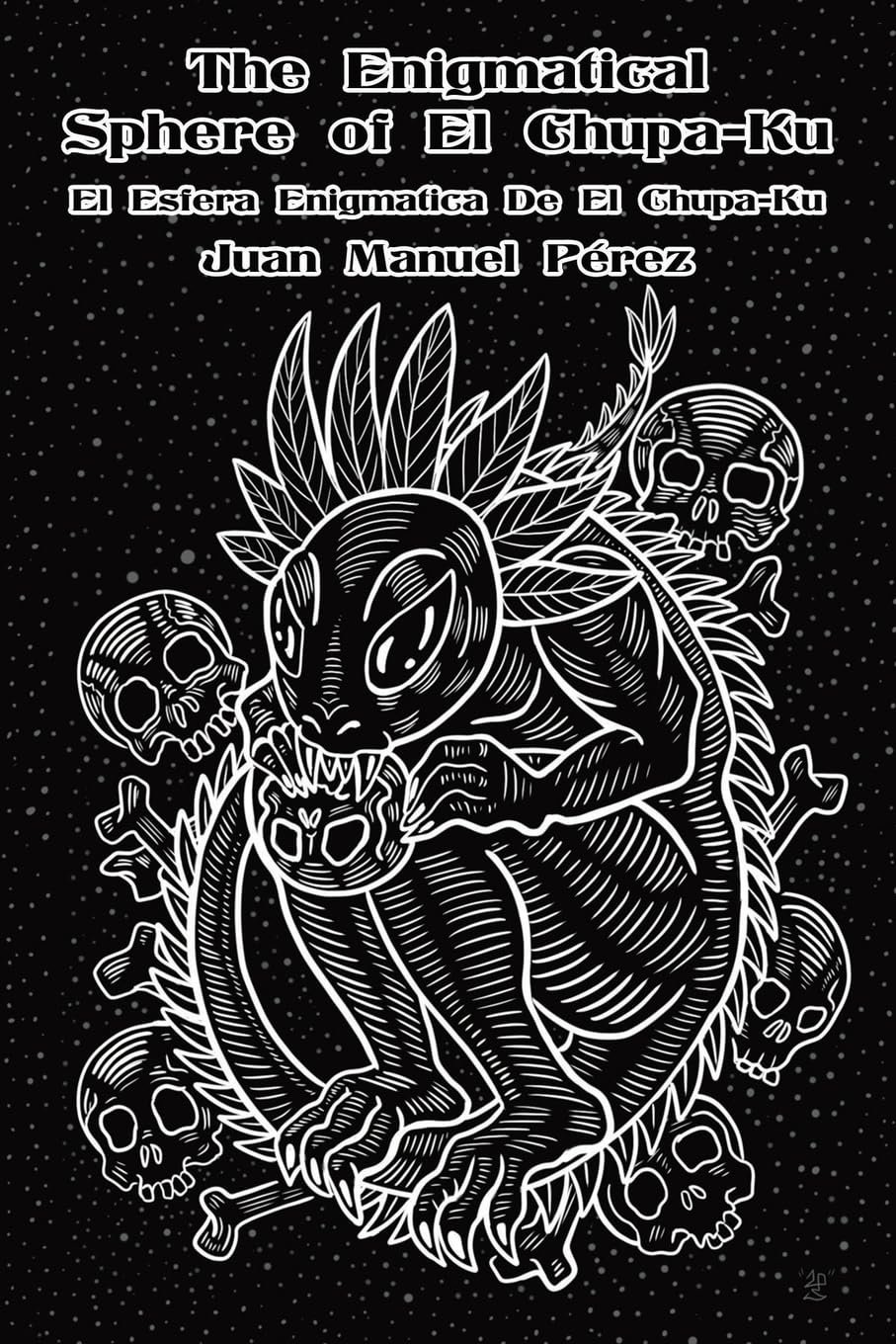
Click on cover image to purchase a copy
MWSA Review
Writing from the perspective of a Mexican American Marine veteran of indigenous descent, the poet uses haiku poems to breathe life into and resurrect the legend of the chupacabra. This is not a traditional, somber exploration of nature, but rather a dance between the terrifying and the hilarious.
The chupacabra, often translated from Spanish as "goat sucker," is a legendary creature rooted in Latin American folklore, known for allegedly attacking livestock and draining their blood. It’s described as a two-legged, alien-like animal about four feet tall with spikes along its back, large eyes, and a reptilian-kangaroo appearance.
The chupacabra emerges not as a one-dimensional folklore predator but as a transformational archetype—vampiric killer, misunderstood outcast, pop culture icon, and metaphor for primal drives. El chupacabra becomes an all-encompassing lens: horror icon, comedic antihero, mysterious unsubstantiated predator, and cultural symbol.
The poet blends traditional three-line 5-7-5 syllable haiku structure with irreverent humor—pairing Godzilla fights, Mars colonies, personal ads, and tequila-drunk dances while grounding the absurdity in South Texas landscapes of mesquite trees, full moons, gray hides, and drained livestock.
Far from mere monster mixtures, the poems weave folklore with satire, horror, and poignant melancholy. Lighthearted entries imagine chupacabras in absurd scenarios: writing memoirs, starring in TV shows, wrestling goats, or posting personal ads for fatalistic partners. Darker pieces evoke genuine dread—silent coops, twisted goat faces in morning dew, the gray beast stalking under moonlight—echoing real rural fears of loss and the unknown.
Sharp and witty wording, (“Chupa-Man is born," "chupacabra tipping”), absurd scenarios (chupacabra crawl dance, "Take Your Chupacabra to School Day," radioactive Chupa-Man origin) alternate with chilling vignettes (silent coops, waiting in woods for skeptics, "let your pets come out") and cultural fusion (Olmec nagual meets Cthulhu) create a playful make-believe universe. Wordplay abounds ("Chupa-Khan," "Luchacabrador," "chupacabristas"), and pop-culture crossovers (Godzilla battles, Jimmy Kimmel guests, personal ads seeking "like-minded sucker") keep the tone lively without diluting the horror.
Deeper currents emerge: themes of marginalization ("prejudiced hotel," extinction dismissed), hunger as impartial ("chupacabras do not care / for it is just food"), and imagination as defense ("the only proof between us / fear or not to fear"). The poet subtly critiques human monstrosity ("why worry about / terrible chupacabras / worry about man") while embracing the beast as a kindred spirit: wild, self-serving, unapologetic.
Humor dominates much of the sequence: absurd combinations (Giant Chupacabra vs. King Kong comparing B.O., Chupacabra Flats on Mars, "Married with Chupacabras" TV show) inject levity, while pop-culture nods (Jimmy Kimmel, Scary Monsters Magazine) make it gleefully contemporary. Self-referential humor ("I don't always write / poems about chupacabras / ...who am I kidding") acknowledges the mania, yet the collection never flags.
By reimagining the chupacabra through gallows humor and rhythmic brevity, the author invites us to look past the shadow in the mesquite woods and recognize the "code of life" that governs all survivors.
It is a masterful blend of regional folklore, veteran grit, and playful poeticism. The collection celebrates imagination as proof against skepticism, turning a regional legend into a mirror for human fears, hungers, and absurdities.
Ultimately, the poet argues that belief in monsters (chupacabras or otherwise) confronts deeper anxieties: "you believe in ghosts / I, in el chupacabras / which makes us less scared." A masterful blend of folklore, satire, dread, and cultural pride. Highly original and endlessly re-readable.
Review by Frank Taylor
Author's Synopsis
Bilingual Edition
Just when you thought it was safe to liberate beautiful and natural haiku into the eloquent abode of nature, only to be violently attacked by a horrid, supernatural hybrid called el chupa-ku. Combining the simple, American haiku form with the legend and lore of el chupacabras, this unassuming, little book of short poems packs a swift kick to the literary pants in two languages: English and Spanish. Truly, this book can only be enjoyed in the dim-lit hours of the night with a bottle of mescal. ¡Orale!
Format(s) for review: Paper Only
Review genre: Poetry—Poetry Book
Pages/Word count: 114 / 2,426